A “blackout” refers to the complete or partial absence of memories for a period during which a person was heavily intoxicated — even though they were awake, functional, and apparently present throughout. The person experienced the events, but never transferred them into lasting memory.
The crucial distinction: this is not unconsciousness. It is a failure of memory consolidation.
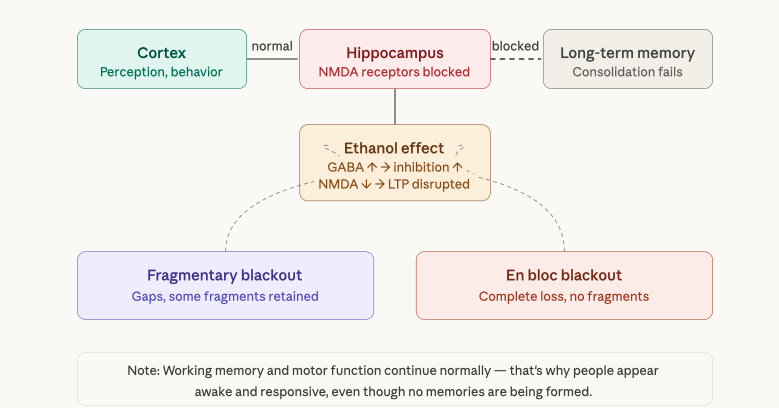
What happens neurobiologically? #
The central site of the process is the hippocampus — the brain structure responsible for transferring experiences into long-term memory (a process called consolidation).
Ethanol interferes via two simultaneous mechanisms:
First, it amplifies the effect of GABA, the brain’s primary inhibitory neurotransmitter. This broadly dampens neural activity — producing the familiar slowing, relaxation, and disinhibition associated with drinking.
Second, it blocks NMDA receptors, a specific class of glutamate receptors. These are critical for long-term potentiation (LTP) — the mechanism by which synapses strengthen during learning and memory formation. Without LTP, no memory trace is written.
The cortex keeps running in the meantime: perception, language, motor function, even decision-making continue to operate — but the “recording” of experience is cut off. Events exist briefly in working memory, but are never encoded into long-term storage.
Two forms #
In a fragmentary blackout (also called a “grayout”), memories are patchy — islands of recollection with gaps in between. People often only realize something is missing when prompted by others.
In an en bloc blackout, the loss is total: no memory whatsoever of the period in question, no fragments, no clues. This occurs at very high blood alcohol concentrations.
Why does this matter? #
A blackout is not merely a curious phenomenon — it signals that the brain was in a state where actions were still possible, but no self-regulation through memory was taking place. People in this state can make decisions they will have no recollection of afterward — not because they are being dishonest, but because the memory was simply never formed.

Bernd Guzek, MD, PhD #
Physician, author & co-founder of Bye-Bye-Booze
Specialized in biochemical mechanisms of addiction and brain metabolism.


