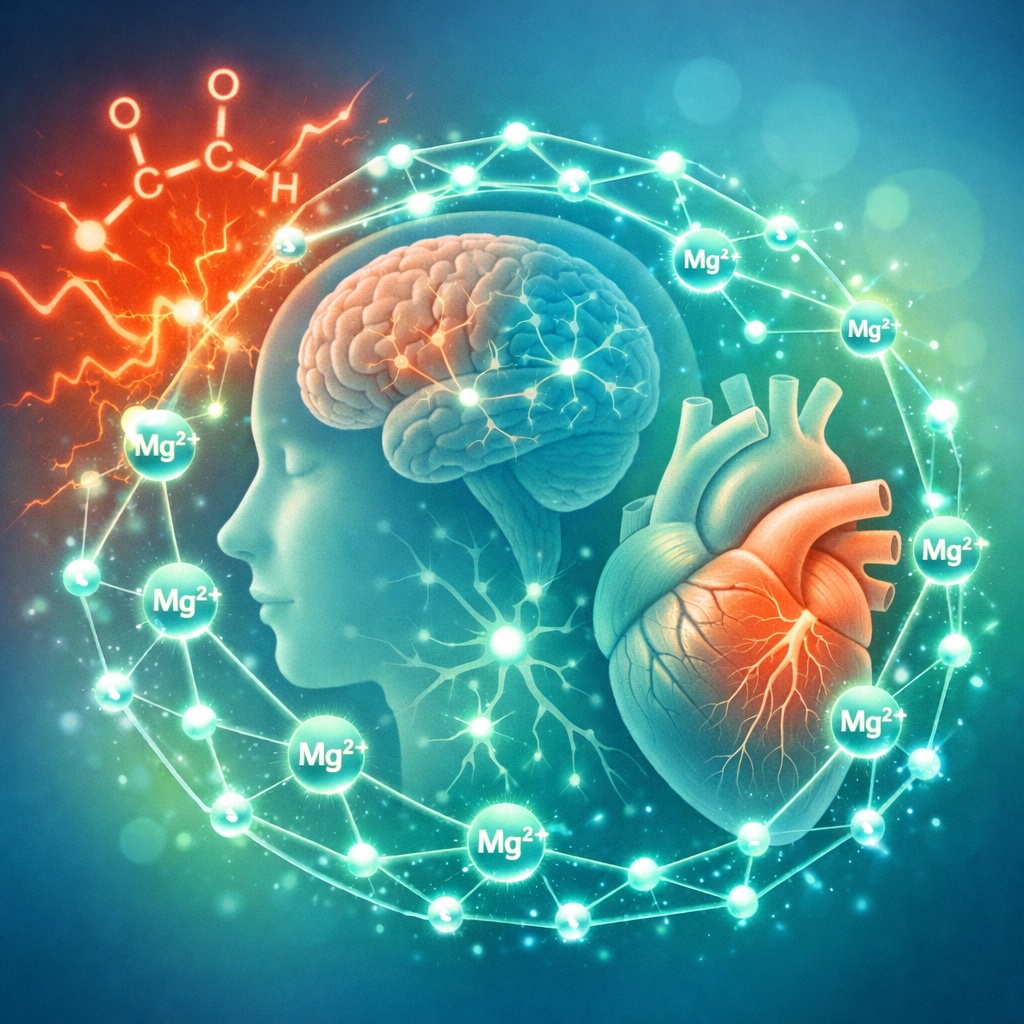
Magnesium plays a bigger role in alcohol withdrawal than most people realize. Long-term alcohol use often leads to magnesium deficiency—with real consequences for the nervous system, heart, and energy metabolism. Tremors, racing heart, inner restlessness, or extreme fatigue can all feel more intense as a result. This post explains why standard blood tests can be misleading and which forms of magnesium make the most sense.
By Bernd Guzek, MD, PhD
Magnesium: The Underestimated Factor in Alcohol Withdrawal
Alcohol deeply disrupts metabolism. The liver breaks down ethanol, the brain adjusts its signaling, and the heart responds to altered electrolytes and elevated stress hormones.
One aspect that often receives too little attention is the mineral balance—especially magnesium.
Multiple studies show that chronic alcohol consumption is almost always associated with low magnesium levels. Depending on the study and patient group, 30–80 % of individuals are affected—sometimes clearly measurable in blood, sometimes more as a functional tissue-level shortage.
Magnesium is involved in over 300 enzymatic reactions. It stabilizes our energy currency ATP, regulates nerve and muscle excitability, and helps maintain calm electrical activity in the heart. When levels drop, the threshold for excitation falls: nerve cells and muscles become overly reactive.
This is exactly where alcohol’s biochemical effects overlap with classic withdrawal symptoms: tremors, inner restlessness, sleep disturbances, racing heart, or muscle cramps.
Alcohol depletes magnesium through several pathways: reduced intestinal absorption, increased renal excretion, and redistribution into compartments where it is no longer available. Poor diet often compounds the issue. The result is rarely a sudden total loss, but rather chronic metabolic instability.
Magnesium does not replace professional detox treatment or medical supervision. Still, it helps explain why the nervous system becomes so sensitive during withdrawal and why physical (vegetative) symptoms can sometimes feel disproportionately strong—beyond what purely psychological factors would predict.
Withdrawal is not only a matter of willpower and mindset—it is also a biochemical challenge. Magnesium plays a central, frequently overlooked part in that process.
Magnesium and the Hyperexcitable Brain
The central nervous system does not react passively to chronic alcohol exposure—it actively adapts. Alcohol mainly dampens excitatory signaling, particularly the glutamatergic system via NMDA receptors. To compensate for this artificial braking, the brain increases the number and sensitivity of these receptors over time.
As long as alcohol is supplied regularly, this adapted balance remains relatively stable. When alcohol suddenly stops, the upregulated counter-regulation runs unchecked: the brain enters a state of massive hyperexcitability driven by excess glutamate.
This is precisely where magnesium becomes critical.
Under normal conditions, magnesium physiologically blocks the NMDA receptor: it sits like a natural plug in the receptor’s calcium channel, preventing excessive activation at typical glutamate levels. This voltage-dependent block is an important safety mechanism against overexcitation.
When available magnesium drops—as frequently happens in chronic alcohol use and withdrawal—this brake loosens. The NMDA receptor becomes more sensitive, allows more calcium influx, and markedly amplifies glutamatergic overactivity.
Magnesium Deficiency in Alcohol Withdrawal – Typical Symptoms
The outcome: neuronal excitation threshold drops further, intensifying classic withdrawal symptoms:
- Tremors
- Inner restlessness and feeling driven
- Increased startle response
- Sleep disturbances and nightmares
- In severe cases, even seizures or delirious states
Important: Magnesium deficiency does not cause alcohol withdrawal. Withdrawal arises primarily from neuroadaptive changes (glutamate-system upregulation). But accompanying low magnesium acts like an amplifier—it removes a natural brake from the already revved-up system, making neuronal instability far more noticeable.
Many people describe exactly this sensation: feeling “wired,” as if the nervous system is running at full throttle. Biochemically, this is not just subjective—it reflects a real, measurable increase in excitability.
In this context, magnesium does not primarily sedate (like benzodiazepines) but stabilizes: it raises the excitation threshold again, supports return to more normal balance, and can help reduce the intensity of autonomic and neurological symptoms.
Of course, this does not replace medical withdrawal management. Yet it clearly shows: withdrawal is a neurobiochemical event—and magnesium is a key, often underestimated building block.
Heart, Rhythm, and Autonomic Instability
Magnesium influences not only the central nervous system but also the electrical stability of the heart—very directly.
Every heart muscle cell relies on precisely tuned ion flows: sodium enters, potassium exits, calcium triggers contraction. These currents generate the electrical signal that coordinates the heartbeat. Magnesium acts in the background as a key regulator: it stabilizes cell membranes, modulates potassium and calcium channels, and ensures orderly excitation without chaotic after-discharges.

When available magnesium falls, this delicate balance shifts. The excitation threshold of heart muscle cells drops; they react more sensitively to minor triggers. The risk of premature beats (extrasystoles) or transient rhythm disturbances rises noticeably.
Magnesium and potassium are tightly linked. Low magnesium often promotes secondary potassium loss via the kidneys or hinders repletion. Together—low magnesium plus relative potassium shortage—the heart becomes even less stable. During alcohol withdrawal, this biochemical weakness meets additional strain:
- Adrenaline and noradrenaline surge
- The sympathetic nervous system stays chronically activated, generating stress
- Pulse and blood pressure fluctuate widely
- The autonomic nervous system enters a highly labile state
In this already tense phase, accompanying magnesium deficiency markedly lowers the heart’s electrical stability threshold. Common complaints include:
- Strong racing heart (tachycardia)
- Irregular or “skipping” pulse
- Noticeable extrasystoles (feeling that the heart “skips” or adds an extra beat)
- Circulatory instability, dizziness
- Cold sweats
Not every symptom stems solely from magnesium deficiency—the withdrawal itself drives massive sympathetic activation. Yet a deficit frequently amplifies these complaints and makes them feel more threatening. Many describe exactly this “heart pounding with panic,” where physical and psychological elements become hard to separate. Electrolyte imbalance often contributes meaningfully.
Here, magnesium does not primarily calm or sedate. Instead, it restores electrical order in heart muscle, raises the excitation threshold, and promotes stability—especially when the entire autonomic system is under extreme demand.
This explains why some people report: “Once my magnesium improved, the racing heart noticeably calmed—without needing extra medication.” It is not a cure-all, but an important piece for greater stability.
Oxidative Stress, Energy, and Cell Protection – Magnesium’s Hidden Role
Alcohol stresses the body beyond nerves and cardiovascular system—it reaches deep into cellular energy metabolism.
Ethanol breakdown in the liver generates excess reactive oxygen species (ROS)—free radicals and other aggressive molecules. The NADH/NAD⁺ ratio shifts heavily toward NADH, impairing the mitochondrial respiratory chain: cellular energy production stalls and efficiency drops. This is called oxidative stress—a state in which antioxidant defenses are overwhelmed.
Magnesium plays a central though often overlooked role here.
Nearly every energy-rich reaction uses Mg-ATP—the magnesium-bound complex—rather than free ATP. Magnesium stabilizes the ATP molecule, prevents premature breakdown, and makes it fully usable for enzymes. When magnesium availability falls, these processes become less efficient—cells produce less usable energy despite available raw materials.
Magnesium also supports numerous enzymes that stabilize cell membranes and control repair mechanisms. Deficiency does not always cause immediate cell damage, but it sharply reduces cells’ stress reserves. They react more sensitively to additional stressors, and regeneration slows.
In alcohol withdrawal these effects accumulate:
- The body already fights inflammatory responses (cytokines, microglial activation)
- Hormonal axes (cortisol, catecholamines) are upregulated
- Neuronal hyperexcitability consumes extra energy
When mitochondrial energy production and enzymatic stabilization are suboptimal under these conditions, people feel it directly: marked physical exhaustion, muscle weakness, rapid fatigability, a vague sense of “no power left.” Many wonder why tiredness persists so stubbornly despite sleep and food. A relevant part of this is metabolic, not purely psychological.
Important: Magnesium is not a classic antioxidant like vitamins C or E—it does not directly neutralize free radicals. Its strength lies in indirect support:
- Stabilizing mitochondrial energy production
- Maintaining ATP availability
- Supporting enzymatic protection and repair systems
In a phase when metabolism is already under high pressure, this stabilizing function can make the difference—between barely hanging on and slowly rebuilding strength.
Magnesium does not cure oxidative stress or replace detox or therapy. But it helps the body better maintain its own protection and repair mechanisms—often providing noticeable relief in the first weeks of withdrawal.
Why Normal Blood Levels Often Don’t Reassure – The Magnesium Trap
Routine testing usually measures serum magnesium. In many people during withdrawal the value falls in the normal (“green”) range—and that initially seems reassuring. “Labs okay, so everything’s fine,” people think.
In reality, serum reflects only a tiny fraction of total body magnesium: roughly one percent circulates in blood. About 60 percent resides in bone, 30–40 percent in muscle and soft tissue, and the rest inside cells of all organs.
The body tightly regulates this extracellular (blood) level because magnesium is essential for vital functions: heart rhythm, nerve conduction, enzyme activity. When tissue or cellular availability drops, the body quickly mobilizes reserves from bone and muscle to keep serum stable—often for weeks or months.
Result: A normal serum value does not reliably rule out a relevant functional magnesium deficit. This is a well-known phenomenon in chronic alcohol use and withdrawal: intracellular and tissue availability can be markedly reduced while the lab value remains within reference range (typically 0.70–1.05 mmol/L, depending on the lab).
In practice, deficiency often shows up clinically rather than in labs:
- Persistent tremors despite benzodiazepines
- Stubborn racing heart or extrasystoles
- Strong inner restlessness and startle response
- Muscle weakness, cramps, or diffuse exhaustion
- Sleep problems not fully explained by psychology
This does not mean blood tests are useless. A clearly low serum magnesium (< 0.70 mmol/L, often symptomatic below 0.60 mmol/L) is a red flag requiring immediate replacement—usually intravenous in the acute phase. But the reverse is not true: a normal value should not create false security.
In alcohol withdrawal, lab values should always be interpreted in context:
- Symptom pattern
- Duration and intensity of prior consumption
- Nutritional status (often low in magnesium-rich foods)
- Comorbid conditions (cirrhosis, malabsorption, diuretics, etc.)
- Course of withdrawal symptoms
Magnesium exemplifies how lab parameters provide valuable guidance—but never the full physiological picture. When symptoms persist despite “normal” values, biochemical factors often play a larger role than initially assumed. Dismissing them too quickly as “purely psychological” or “withdrawal anxiety” can miss important stabilization options.
Supplementation – Very Reasonable, But No Miracle Cure
When relevant magnesium deficiency exists—whether lab-confirmed or clinically likely from symptoms and history—targeted supplementation is medically reasonable and often helpful. In chronic alcohol use and withdrawal, multiple factors converge: increased renal losses, reduced gut absorption, poor diet, and higher demand from stress and inflammation.
Adequate magnesium intake in this phase can support:
- Raising neuronal excitation threshold
- Improving cardiac electrical stability
- Stabilizing cellular energy production
- Calming the autonomic nervous system somewhat
Many people experience noticeable relief: less extreme tremors, milder racing heart, more inner calm, and faster recovery from exhaustion.
Important caveat: Magnesium does not replace professional detox therapy. It prevents neither delirium tremens nor severe seizures in high-grade dependence. In such cases, medical monitoring, short-term benzodiazepines, fluid/electrolyte balancing, and thiamine (vitamin B1) remain essential. Magnesium can flank stabilization—but it does not treat the underlying addiction or cover primary neuroadaptation.
Key Points for Supplementation
- Dosage & Tolerability Typical therapeutic doses are 200–400 mg elemental magnesium daily (sometimes briefly higher, physician-guided). Split higher doses into 2–3 intakes to optimize absorption and spare the gut.
- Check Kidney Function With normal kidney function (GFR > 60 ml/min), moderate oral supplementation is safe. With impaired function (GFR < 30–40 ml/min) or serious arrhythmias, always coordinate with a physician.
- Interaction with Other Electrolytes Magnesium and potassium balance are closely linked. Isolated potassium replacement without magnesium correction often remains incomplete—the kidneys continue losing potassium while magnesium stays low. Monitor both.
What Happens in Overdose?
With healthy kidneys, magnesium is one of the safest minerals. Excess is excreted renally. The most common (and dose-limiting) side effect of higher oral doses is diarrhea—osmotic, because unabsorbed magnesium binds water in the gut. This acts as a natural safety valve: the body simply absorbs less when intake is too high.
At usual oral supplement doses (200–600 mg/day), clinically relevant complications are extremely rare with normal kidney function.
Which Form Makes Sense?
Magnesium in tablets or powders is never pure—it is always bound to a carrier. Bioavailability and tolerability vary widely:
- Magnesium oxide Cheap, high elemental content (~60 %), but only 4–10 % bioavailable. Frequently laxative, often causes GI upset. Despite high mg numbers on the label, usually the poorest choice for effective repletion.
- Better organic forms (higher absorption, better tolerated):
- Magnesium citrate – highly soluble, very good uptake, moderately laxative at high doses
- Magnesium bisglycinate (glycinate) – chelated, very gentle on stomach, minimal laxative effect, excellent cellular uptake
- Magnesium malate – often preferred for fatigue and muscle weakness, supports energy production
In practice, the highest mg number on the label matters less than the combination of actual absorption and tolerability. A moderate citrate or glycinate dose (e.g., 2 × 150–200 mg elemental) usually delivers more than a cheap oxide product with 400 mg where only a fraction arrives.
Quick daily rule: Choose a well-soluble organic form. Start moderate (e.g., 200–300 mg elemental/day), spread across the day. Monitor tolerability and symptoms. If uncertain (kidney values, heart rhythm, other medications), always check with a doctor or pharmacist.
Magnesium is a valuable building block—but only one. It can noticeably ease withdrawal without being a miracle cure.
Magnesium in Alcohol Withdrawal – Key Takeaways
Chronic alcohol use disrupts magnesium balance on multiple levels: reduced gut uptake, increased kidney loss, and often inadequate diet. The result is rarely a dramatic single lab finding, but insidious functional instability.
Magnesium affects nerve cell excitability, heart electrical stability, and cellular energy efficiency. In the high-stress phase of alcohol withdrawal, deficiency can amplify this instability. Tremors, restlessness, palpitations, or profound fatigue are not purely psychological—they reflect an organism under biochemical strain.
Magnesium does not replace detox therapy or medical care. It is no miracle. Yet it is among the factors frequently overlooked, even though it can contribute to stabilization.
Withdrawal involves adaptation on multiple levels. Considering the biochemical side helps explain why stability sometimes depends on seemingly small adjustments—and why magnesium can play a meaningful role.
If you are currently in withdrawal or supporting someone: don’t overlook the biochemical side. Talk to your doctor—checking electrolytes more closely can help more than you might expect.
Frequently Asked Questions about Magnesium and Alcohol Withdrawal (FAQ)
Can magnesium deficiency intensify tremors during alcohol withdrawal?
Yes. Low magnesium lowers the neuronal excitation threshold. It physiologically blocks the NMDA receptor, dampening excessive glutamate-system activity. When levels drop, the nervous system reacts more sensitively. Tremors, restlessness, and heightened startle response can become more pronounced. Deficiency does not cause withdrawal, but it can amplify it.
Does magnesium help with racing heart during alcohol withdrawal?
Magnesium stabilizes heart muscle cell electrical activity and influences potassium balance. Withdrawal sharply increases sympathetic drive, causing pulse and blood pressure swings. Additional magnesium deficiency lowers electrical stability. Targeted supplementation can soften palpitations or extrasystoles, but never replaces medical monitoring in severe cases.
Why are magnesium blood levels often normal despite symptoms?
Only about one percent of total body magnesium circulates in blood. The body keeps serum levels relatively constant by mobilizing reserves. A normal blood value therefore does not reliably exclude a functional tissue or cellular deficit. Assessment should always consider symptoms, nutrition, and alcohol history together.
Which magnesium form is useful for alcohol-related issues?
Well-soluble organic compounds such as magnesium citrate, bisglycinate, or malate are usually better absorbed and tolerated than oxide. The highest mg number on the label matters less than actual absorbed amount. Moderate doses spread throughout the day usually improve tolerability.
Can you overdose on magnesium?
With normal kidney function, relevant overdose from typical oral supplements is rare. High doses usually cause diarrhea first, limiting absorption. Accumulation becomes problematic mainly with impaired kidneys or intravenous administration. In those cases, fatigue, muscle weakness, or low blood pressure may occur.
Recent Posts in Our Blog
- Magnesium in Alcohol Withdrawal – Why a Deficiency Can Worsen Symptoms
- Chronic Fatigue and Alcohol
- Brain Damage from Vitamin Deficiency in Alcoholics: An Often Overlooked Danger
- The Hidden Cancer Risk in Alcohol: Biological Causes and Key Organs Involved
- Histamine and Alcohol: Why a Single Glass of Wine Triggers Heart Palpitations and Anxiety
- Heart Arrhythmias from Alcohol: How One Drink Too Many Can Make Your Heart Stumble
- Why Heavy Drinking Ultimately Kills Your Sex Drive and Performance
- Alcohol: The number one killer of the pancreas
- Sober at Last – Yet Unhappy
- Alcohol and Sleep: Why You Jolt Awake at 3 AM

Bernd Guzek, MD, PhD
Physician, Author, Family Member & Co-Founder of Bye Bye Booze
Has spent many years studying the biochemical foundations of addiction and brain metabolism disorders, as well as their modulation by nutrients.