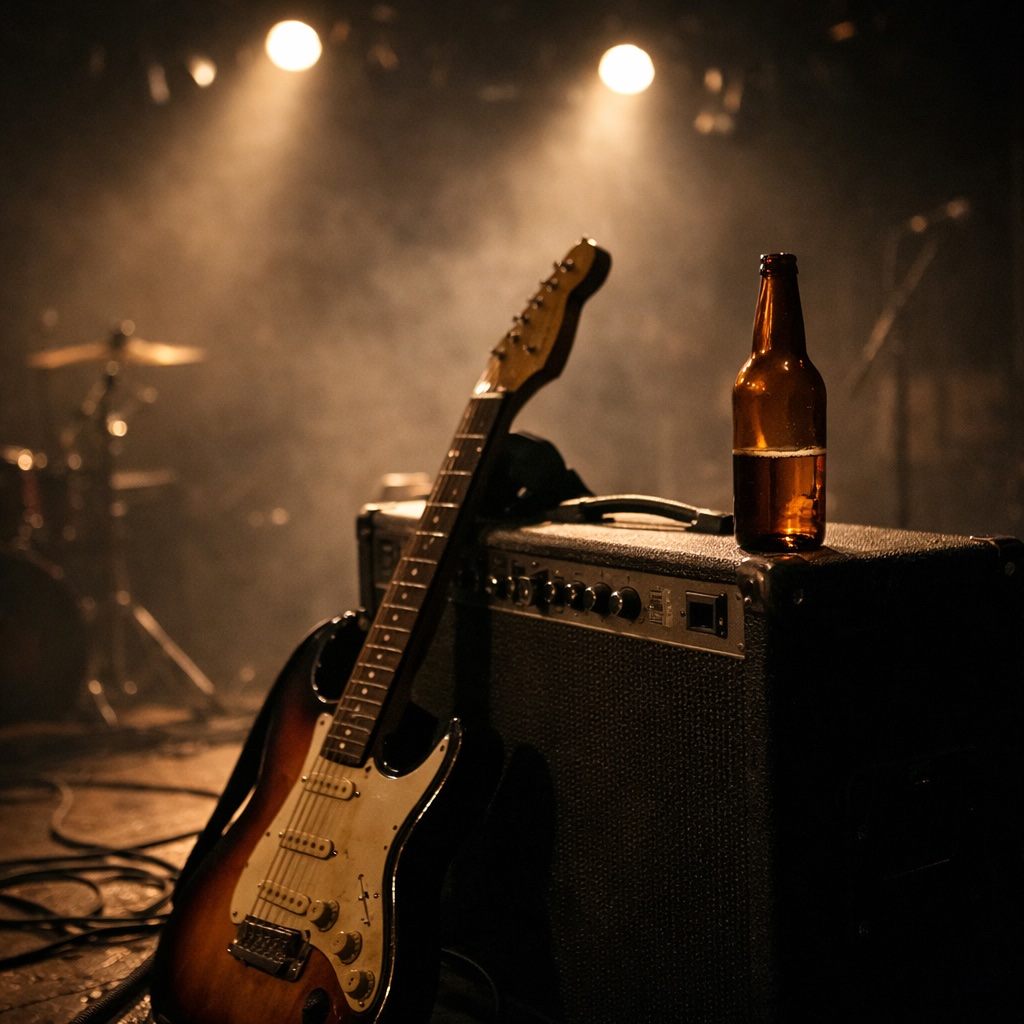
Alcohol is practically part of everyday life in the music industry. Backstage, after concerts, or on tour – beer, wine, and other substances often belong to the routine. Numerous biographies of famous musicians show how quickly rituals can turn into addiction. This article explains why alcohol plays such a big role in musicians’ lives – and what health consequences it can bring.
By Bernd Guzek, MD, PhD
“Wake up in the hotel, drive to the next venue, check in, set up, soundcheck, grab a quick bite, play the show, tear down – and sometime after midnight back at the hotel. Then comes the debrief. And I hardly know any musician who doesn’t have a beer or a glass of wine during that time.” That’s how one member of the anonymous Alkohol ade forum describes the exhausting routine on tour.
Anyone who has ever stood on stage knows the feeling: the performance is over, the audience is gone, but adrenaline is still racing through the body. You’re wired, conversations flow, impressions are processed – and almost always alcohol is on the table. What starts as a harmless post-show ritual becomes, for many, the entry point into a creeping addiction.
Tragic Icons: When the Voice Falls Silent
The link between music and alcohol use disorder is far from rare – countless biographies prove it. One especially tragic case is Amy Winehouse. The British singer was a true phenomenon. Her deep, expressive alto was compared to jazz legends like Billie Holiday. Yet as her career skyrocketed, addiction took over. In 2011, at just 27, she died of alcohol poisoning. Her blood alcohol concentration was 0.416% – more than five times the legal driving limit – and three empty vodka bottles were found beside her.
Vodka was also the preferred “helper” for Eddie Van Halen. The virtuoso rock guitarist and songwriter battled severe alcohol and drug addiction throughout his life. Shockingly, his own father – himself a musician – gave him his first glass of vodka at age twelve to calm his stage fright. Eddie quickly learned to use alcohol as a tool to lower inhibitions and cope with social anxiety.
Later he described himself as someone who didn’t drink to party, but to perform in the studio and on stage – to simply function. The price was devastating: As a chain smoker and heavy drinker, he combined two major risk factors for tumors of the mouth, nose, and throat. In 2007, part of his tongue had to be removed due to tongue cancer. Only afterward, after several withdrawal attempts, did he achieve lasting sobriety – only to later develop throat cancer, which took his life in 2020 at age 65.
When the Body Sends the Bill: Wecker and Clapton
You don’t have to cross the Atlantic to find musicians struggling with alcohol. German singer-songwriter Konstantin Wecker thrilled fans for decades – until he unexpectedly had to cancel all upcoming tour dates in late 2025/early 2026 due to illness. The reason: severe nerve damage in his left hand. Wecker himself attributes this polyneuropathy directly to decades of alcohol misuse. He achieved sobriety in 2022, but the step apparently came too late to reverse the nerve damage. Today, he can barely play piano professionally – the instrument that built his career.
British guitarist Eric Clapton had similar experiences. His success was long overshadowed by intense battles with addiction. After overcoming heroin dependency in the early 1970s, he fell into massive alcohol addiction for about thirteen years. Only at age 42 did he find the path to sobriety – a turning point closely tied to his desire to be a responsible father.
The years of excess left lasting marks: Like Wecker, Clapton developed peripheral polyneuropathy from alcohol, which increasingly impairs his mobility and guitar playing. This nerve disorder can still partially reverse with consistent sobriety up to a certain point – miss that window, and the damage becomes permanent.
To help others, he founded the Crossroads Centre on Antigua in 1998, a specialized addiction treatment facility. Clapton also long supported the work of Alcoholics Anonymous and speaks openly about his recovery.
The Push–Pull Dynamic of “Uppers” and “Downers”
Alcohol plays such a frequent role in musicians’ lives partly because of the unique dynamics of performing. Before a show, many try to stay alert and focused – often with coffee, cola, or energy drinks, classic “uppers.”
A small sip of wine or beer then provides the necessary disinhibition. On stage, adrenaline surges, creating a state of high activation. After the concert, the pendulum swings back. The body remains tense, sleep is nearly impossible. In this phase alcohol acts as a “downer,” calming inner restlessness and helping to wind down.
This creates a daily pattern in many bands of ramping up and then dialing down. Such biographies illustrate how easily alcohol can become entrenched in a musician’s routine.
“The group relaxes, gets cheerful, and often there’s still some weed going around – though that was never my thing,” the anonymous forum musician continues. “You usually need at least those two hours to come down from the show. I think that’s normal after working ten hours until midnight. Quite often you don’t even make it to breakfast the next morning.”
What may begin as a harmless post-concert ritual often solidifies over years into a fixed habit – with health consequences that only become visible much later. After shows, musicians sit together for a long time before heading to the hotel. The evening winds down, conversations continue, and there’s usually a drink on the table.

Frequently Asked Questions about Alcohol in the Music Scene (FAQ)
Why do so many musicians drink alcohol after concerts?
After a performance the body is still flooded with adrenaline. Many musicians say they need several hours to calm down. In this situation alcohol acts as a sedative and is therefore often used to reduce inner tension.
Is alcohol really that common in the music scene?
Biographies of many well-known musicians show that alcohol and other drugs have played a role in the music world for decades. Tour life, long working hours, and the special dynamics of live performances can easily turn alcohol into a habit.
Can alcohol cause permanent nerve damage?
Yes. Chronic alcohol use can cause so-called alcoholic polyneuropathy. Peripheral nerves are damaged, leading to numbness, pain, or coordination problems. Early sobriety improves the chances of partial recovery.
Can alcohol-related polyneuropathy improve again?
In early stages nerves can partially regenerate if the person remains consistently sober. Peripheral nerves have limited regenerative capacity. In advanced cases, however, permanent limitations often remain.
Recent Posts in Our Blog
- PAWS After Alcohol Withdrawal: When Relapse Comes Knocking
- Niacin: A Key Vitamin for People Recovering from Alcohol Dependence
- The Addiction Memory: Why the Brain Never Forgets Alcohol – and How We Can Still Break Free
- Between Spotlight and Crash: Why Alcohol Is So Prevalent in the Music Scene
- Tingling and Numbness in the Feet – Recognizing Alcohol-Related Polyneuropathy
- Magnesium in Alcohol Withdrawal – Why a Deficiency Can Worsen Symptoms
- Chronic Fatigue and Alcohol
- Brain Damage from Vitamin Deficiency in Alcoholics: An Often Overlooked Danger
- The Hidden Cancer Risk in Alcohol: Biological Causes and Key Organs Involved
- Histamine and Alcohol: Why a Single Glass of Wine Triggers Heart Palpitations and Anxiety

Bernd Guzek, MD, PhD
Physician, Author, Affected Family Member & Co-Founder of Bye Bye Booze
Has spent many years studying the biochemical foundations of addiction, brain metabolism disorders, and their modulation by nutrients.