
“He just wanted to drink.” You’ve probably heard that sentence before. Maybe you’ve even said it to yourself, right in the middle of the shame that follows a relapse. It sounds like a judgment about character. About willpower. About you as a person.
It’s wrong anyway. And it just rehashes the age-old classification of the alcoholic as a morally inferior person. Yet the real explanation isn’t found in psychology, but in our anatomy: the reptilian brain.
Addiction is stored right alongside breathing, heartbeat, the flight reflex, and sex
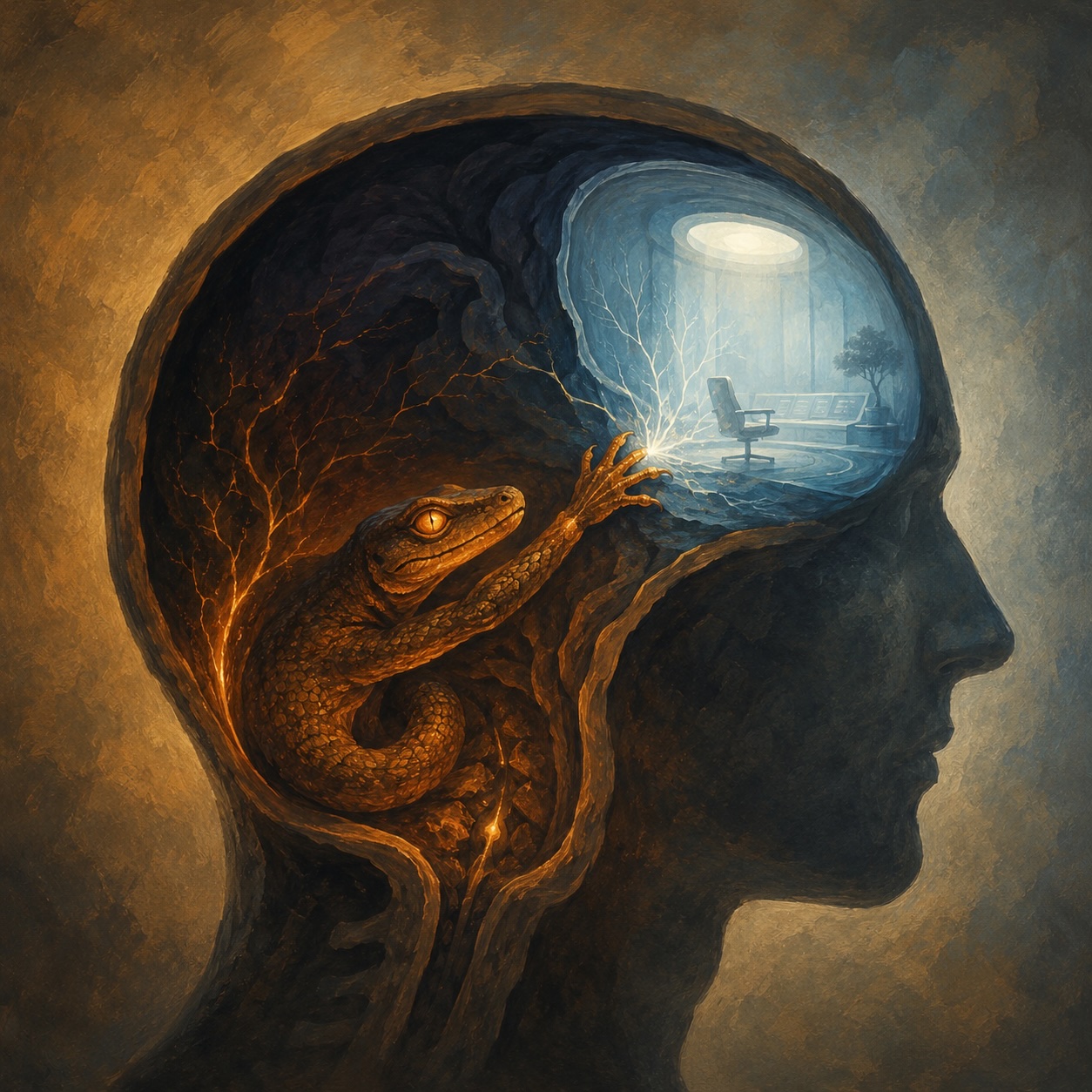
Don’t picture your brain as a single unit, but as a house with several floors built at different times. Down in the basement sits the oldest part – the brainstem and the structures around it, casually called the “reptilian brain.” That’s where the basic program runs: breathing, heartbeat, the flight reflex. Everything needed for survival, without having to think it over in an emergency.
And that’s exactly where addiction gets stored – the information about “how great” alcohol or other drugs are, or were, at making you feel. Right next to hunger, the sex drive, the flight reflex, and everything else. Everything so vital to survival that the brain would never leave it up to slow, deliberate thinking.
That’s exactly where the addiction memory has set up camp. Not as a subtenant, but disguised as part of the permanent staff. Your addiction memory gets filed under the same urgency as food and reproduction: vital to survival, non-negotiable, no compromises. This old system doesn’t distinguish between “I need food” and “I need a drink.” Both ring the same alarm line. Here, the only rule is: “Want it. Get it. Now.”
The power struggle you don’t notice
On the top floor sits the more recently evolved prefrontal cortex – the command center. It weighs things up, plans ahead, remembers consequences. It’s the part that knows: “I don’t want to drink.” That’s the part we reach through addiction treatment, and it has to keep the dumb lizard in check.
During craving, something measurable happens: activity in the prefrontal cortex drops while the older, basement-level areas ramp their activity up. In that moment, your addiction memory is making a direct attempt to take over the command center. And unfortunately, it often succeeds.
What follows feels like a decision. “Just once won’t hurt.” “I’ve got it under control now.” “Just for today.” These sentences sound reasonable. But they aren’t. It’s the basement trying to seize control of the bridge.
Anyone who calls this a moral failing has no clue
This is where a lot of the old guard of addiction therapy are still stuck: the idea that a relapse ultimately comes down to a question of willing or not willing. What they don’t seem to notice is that they’re falling behind even Jellinek, who took alcoholism out of exactly this moral corner – the idea of the supposedly morally inferior drunk – decades ago.
Anyone who still claims this today is ignoring the fact that, in that moment, the decision is no longer being made at the level of reason – it’s happening many floors below, in a region your conscious will never even gets to see.
That’s not an excuse – it’s biology. Weakness of will would mean the command center had full control and simply chose wrong. What actually happens is that a system temporarily shuts the command center down and feeds it its own version of reality instead. That can’t be fixed with more discipline – any more than you can out-willpower a cue reactivity response that’s already running on autopilot.
Understand the lizard, protect yourself from relapse
The good news: once you know the mechanism, you can outmaneuver it – before the old lizard takes over, not just after. That’s exactly what our relapse prevention approach is built on: recognizing triggers, moving the decision moment earlier, catching the basement before it’s already grabbed the wheel. Learn more here.
A note for the sake of completeness: the idea of three separate “brains” neatly stacked on top of each other is already somewhat outdated in neuroscience – research keeps moving forward. The regions are far more intricately interconnected than that old picture suggests. But even the modern models confirm the core finding that matters to you: a very old, very powerful part of your brain can take over control without your conscious mind getting a say.
Often makes sense for our survival – but it gets hijacked by the addiction memory.
Frequently Asked Questions About Relapse After Alcohol Detox (FAQ)
Is a relapse a character flaw?
No. During craving, activity in the prefrontal cortex drops while older brain regions take over control. That’s biology, not a question of willpower.
What is the reptilian brain?
The colloquial term for the oldest part of the brain (the brainstem and surrounding structures), which controls vital programs like breathing or the flight reflex – and where the addiction memory is also stored.
Why does a relapse feel like a conscious decision?
Because the addiction memory generates sentences like “just for today” that sound reasonable. But in that moment, it’s actually the basement that has taken over the bridge, not your conscious will.
Can you counter the reptilian brain during a craving?
Yes – by recognizing triggers before they take effect. That’s exactly what relapse prevention is built on: moving the decision moment earlier instead of reacting only after the basement has already taken over.
Goldstein & Volkow (2011), Dysfunction of the prefrontal cortex in addiction, Nature Reviews Neuroscience: https://www.nature.com/articles/nrn3119