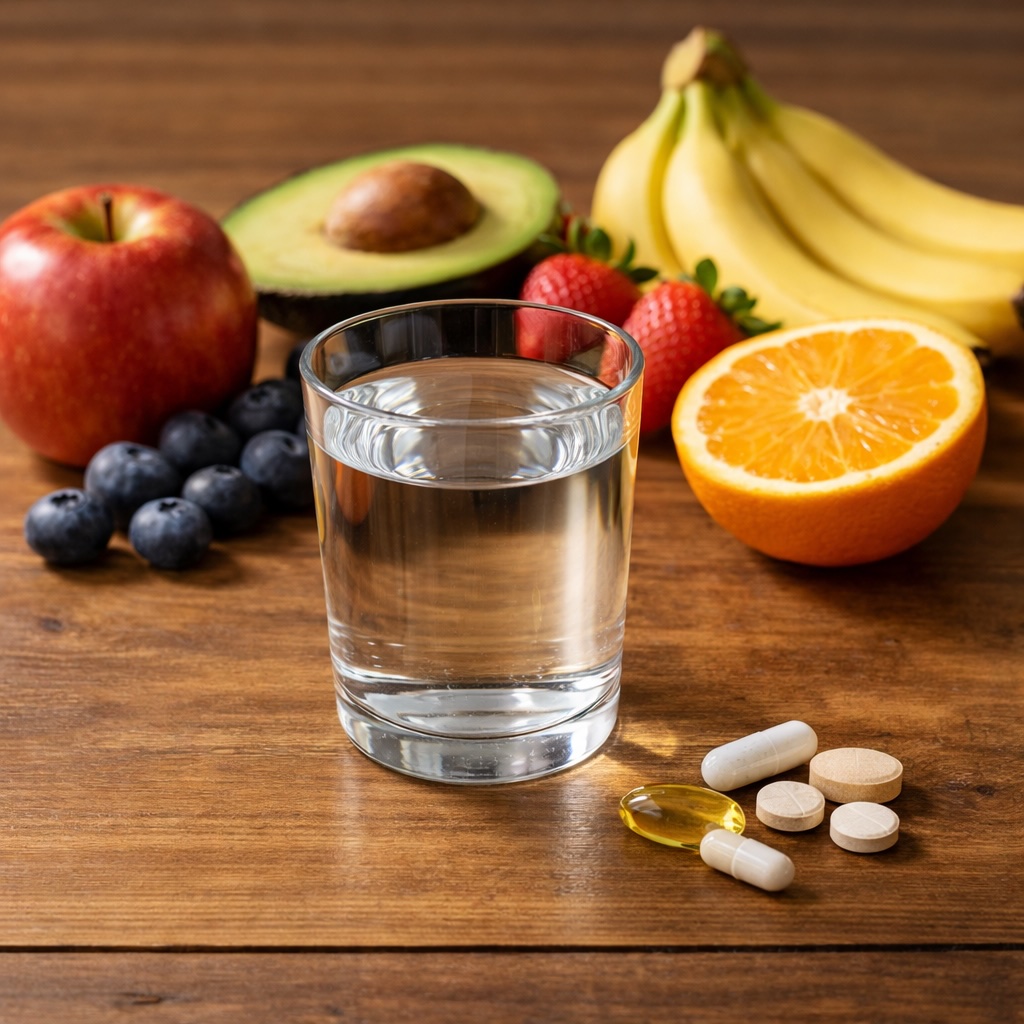
Nutrients alone cannot cure an alcoholic of their addiction. But they make it much easier to keep your hands off the glass. This was already discovered by Bill W., the founder of Alcoholics Anonymous, who cured his depression, anxiety, and panic attacks—which tormented him without alcohol—with a vitamin treatment. However, no one in his organization wanted to know about it anymore. The organization had become independent from Bill and focused solely on psychological causes of alcoholism.
The international research literature is full of studies dealing with nutrient deficiencies in alcoholics. It is clear: everything can be deficient, from Vitamin A to “Z” for Zinc. After I, Gaby Guzek, repeatedly confirmed this in my research, the next step was obvious: Together with my husband Bernd Guzek, MD / PhD, I developed a nutrient concept for myself that allowed me to quit alcohol immediately without noticeable withdrawal symptoms—and, most importantly, I no longer had any drive to start drinking again.
We didn’t invent the use of nutrients for quitting alcohol from scratch. In the US, there are already several clinics that use nutrients to treat alcoholism—with much greater success than conventional treatment methods. Worldwide, there are far more than just one test subject for whom nutrient concepts have made withdrawal easier—and there are also studies to support this.
Learn more about nutrients against alcohol our book “Bye, Bye, Booze”. You can find a free sample chapter here. If you’ve already read the book and are looking for the nutrient protocol—you’ll find it here!
People with alcohol addiction do not have weak willpower or bad character, they have a disrupted brain biochemistry.
Whichever path you choose – we wish you great success. Life without alcohol is possible, and it’s worth it!
Frequently Asked Questions (FAQ)
Yes, nutrients can alleviate withdrawal symptoms and significantly reduce the risk of relapse. They do not replace therapy, but they can make the path out of addiction noticeably easier.Can vitamins and nutrients really help with quitting alcohol?
Yes. Numerous studies show that many people with alcohol addiction have deficiencies in multiple vitamins and trace elements. Particularly common are deficiencies in vitamin B1, B3, and B6, magnesium, zinc, omega-3 fatty acids, vitamin C, proteins, and amino acids. The exact pattern can vary from person to person.Is there scientific evidence for nutrient deficiencies in alcohol addiction?
Together with Bernd Guzek, MD/PhD, she developed a targeted nutrient concept. With this approach, she was able to quit alcohol without noticeable withdrawal symptoms and experienced no ongoing urge to start drinking again.What was the approach in Gaby Guzek’s case?
No. Several clinics in the United States have been using micronutrient-based approaches in the treatment of alcohol addiction for years. Reported success rates are often higher than those of conventional treatment methods alone.Is the nutrient-based approach to alcohol addiction new?
The concept is explained in detail in the book “Bye, Bye, Booze.” A free sample chapter is available, and direct links to the nutrient protocol can also be found on this page.Where can I find more information or the nutrient protocol?
Recommended Scientific Literature about Support of Withdrawal with Nutrients
-
Evangelou A. et al. (2000).
Ascorbic acid (vitamin C) effects on withdrawal syndrome of heroin abusers.
Full text
Summary: High-dose vitamin C was associated with a measurable reduction in withdrawal symptoms in opioid-dependent patients.
Relevance: Demonstrates that micronutrients can influence withdrawal physiology, even outside the alcohol context.
-
Marik P.E., Liggett A. (2019).
Vitamin C deficiency is common in patients with alcohol use disorder.
PubMed
Summary: Reports a high prevalence of vitamin C deficiency in hospitalized patients with alcohol use disorder, often overlooked in routine care.
Relevance: Supports the concept that clinically relevant deficiencies extend far beyond thiamine.
-
Lux-Battistelli C. et al. (2018).
Alcohol withdrawal: possible risk of latent scurvy.
Full text
Summary: Identifies biochemical vitamin C deficiency during alcohol withdrawal and documents symptom improvement after supplementation.
Relevance: Connects laboratory deficiency with common withdrawal symptoms such as fatigue and weakness.
-
Mayberry J.A. (2004).
Scurvy and vitamin C. Harvard DASH Repository.
Full text
Summary: Comprehensive overview of vitamin C physiology, deficiency states, and clinical manifestations.
Relevance: Provides essential background for understanding latent and subclinical scurvy.
-
Lim D.J. et al. (2018).
Vitamin C and alcohol: a call to action. BMJ Nutrition, Prevention & Health.
Full text
Summary: Review and position paper highlighting the neglected role of vitamin C deficiency in chronic alcohol consumption.
Relevance: A key reference arguing for routine assessment and correction of vitamin C deficiency in AUD.
-
Ham B.J., Choi I.G. (2005).
Psychiatric implications of nutritional deficiencies in alcoholism.
Full text
Summary: Reviews common micronutrient deficiencies in alcoholism and their neuropsychiatric consequences.
Relevance: Strongly supports the concept of altered brain biochemistry rather than moral or motivational failure.
-
Jophlin L. et al. (2024).
Nutritional deficiencies in alcohol use disorder and alcohol-associated liver disease.
PubMed
Summary: Modern clinical review detailing the prevalence and mechanisms of nutrient deficiencies across the AUD spectrum.
Relevance: Contemporary, guideline-compatible overview.
-
White B. et al. (2024).
A complex interplay between nutrition and alcohol use disorder.
PMC
Summary: Explores absorption, metabolism, inflammation, gut microbiome, and liver-related mechanisms driving deficiency.
Relevance: Explains why deficiencies persist even after drinking stops.
-
Smith H. et al. (2020).
Thiamine dosing for the treatment of alcohol-induced Wernicke’s encephalopathy.
PMC
Summary: Reviews evidence for thiamine dosing strategies and clinical outcomes.
Relevance: Establishes thiamine as necessary but insufficient on its own.
-
Poikolainen K. et al. (2008).
Magnesium treatment in alcoholics: a randomized clinical trial.
PMC
Summary: Examines magnesium supplementation after detoxification and clinical outcomes.
Relevance: Supports magnesium as a frequent and clinically relevant deficiency.
-
Maguire D. et al. (2022).
Randomised trial of intravenous thiamine and/or magnesium sulphate in alcohol withdrawal syndrome.
Full text
Summary: Tests combined and isolated effects of thiamine and magnesium during acute withdrawal.
Relevance: Highlights cofactor dependencies in nutrient-based interventions.
-
Pauluci R. et al. (2022).
Omega-3 fatty acids for relapse prevention in alcohol use disorder.
PubMed
Summary: Randomized trial showing no significant reduction in relapse rates.
Relevance: Important counterbalance: not all supplements show clinical benefit.
-
Galduróz J.C.F. et al. (2020).
Omega-3 interventions in alcohol dependence.
PMC
Summary: Reviews preclinical and clinical evidence on omega-3 fatty acids and addiction-related outcomes.
Relevance: Explains biological plausibility despite mixed clinical results.